The explosion of Generative AI, Machine Learning clusters, and cloud-native applications has fundamentally changed traffic patterns within data centers. Traditional 100G spine-leaf architectures are rapidly becoming bottlenecks.
For network architects, the mandate is clear: more bandwidth, same footprint.
The migration to 400 Gigabit Ethernet (400GbE) is the answer, and the QSFP-DD (Quad Small Form-factor Pluggable Double Density) has emerged as the industry’s form factor of choice. But not all 400G modules are created equal. Here’s how to navigate the transition—and why Superxon’s 400G portfolio stands out.
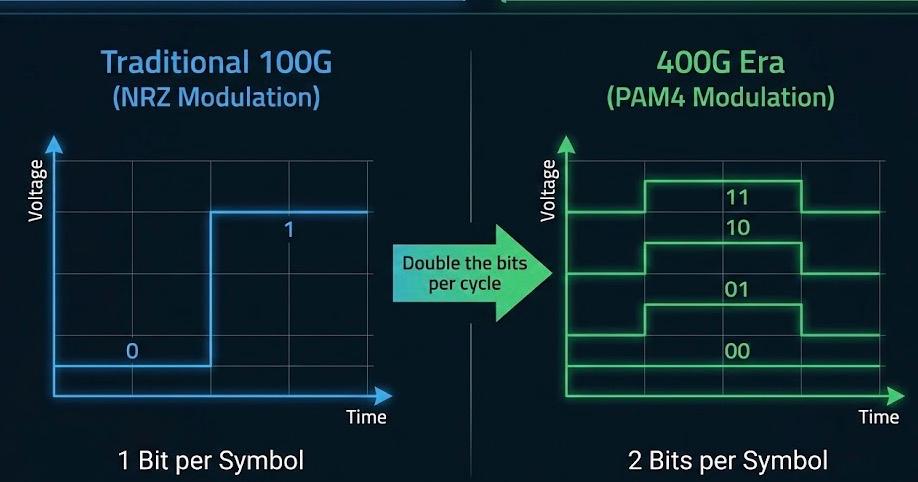
Moving from 100G to 400G isn’t just a speed upgrade; it’s a technological shift.
Unlike previous generations that used NRZ (Non-Return-to-Zero), 400G transceivers relies on PAM4 (Pulse Amplitude Modulation 4-level). This allows twice the data transmission per clock cycle. However, PAM4 demands higher signal integrity and advanced DSP (Digital Signal Processing) to mitigate noise.
While OSFP exists, QSFP-DD has won the data center battle due to backward compatibility with QSFP28 (100G) ports. This enables gradual upgrades without replacing entire equipment racks.
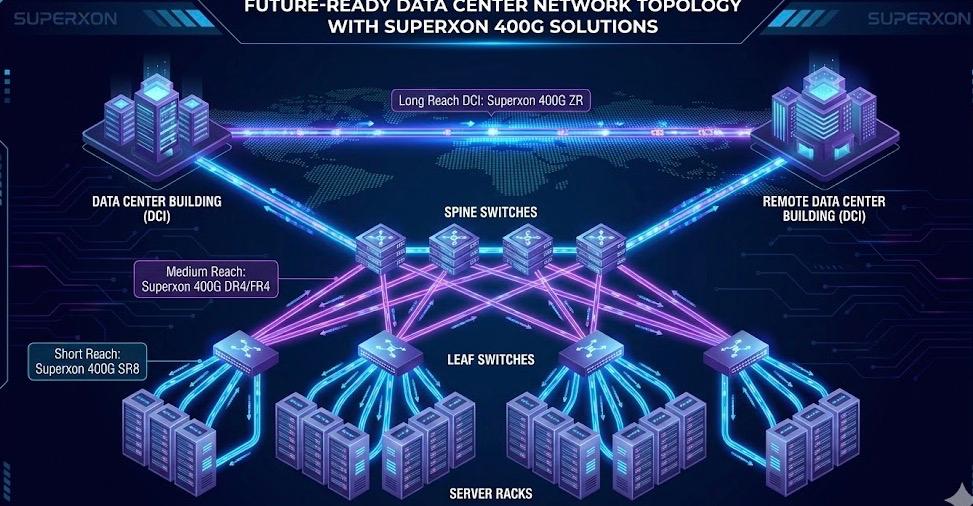
A key 400G deployment challenge is matching transceivers to link distances. Superxon offers tailored solutions for specific network layers:
1. Short Reach (Inter-Rack Connections)
Solution: 400G QSFP-DD SR8
Use Case: Connecting servers to ToR (Top of Rack) switches or short spine-leaf links (up to 100m).
Advantage: Uses parallel multi-mode fiber (MPO-16) for cost-effective short-distance connectivity.
2. Medium Reach (Spine-Leaf / Campus)
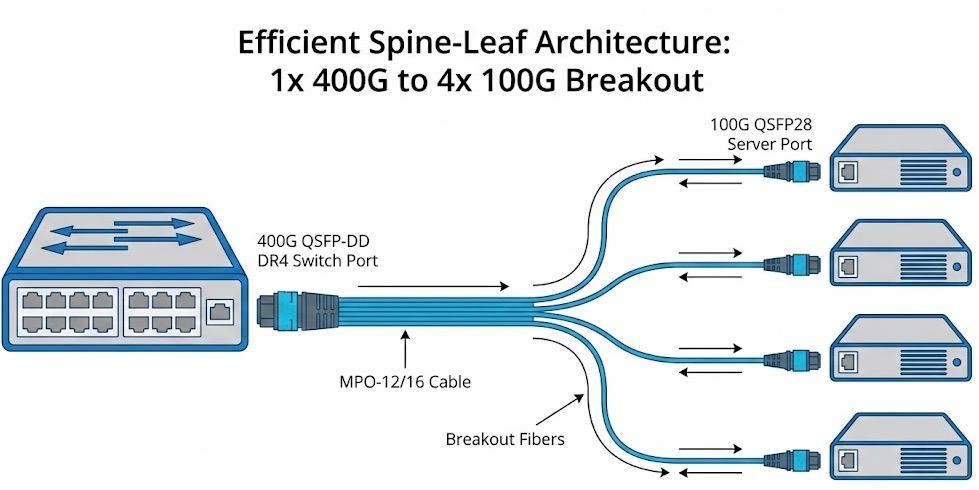
Solution: 400G QSFP-DD DR4 / FR4
Use Case: Workhorses of modern data centers (500m to 2km).
Advantage: DR4 enables 4x 100G breakout (connecting 400G switch ports to 100G servers); FR4 uses CWDM technology to run 400G over single duplex fiber, slashing cabling costs.
3. Long Reach (DCI & Metro)
Solution: 400G QSFP-DD LR4 / ER8 / ZR
Use Case: Connecting geographically separated data centers (10km to 40km+).
Advantage: Ensures high-performance transmission over long distances without complex mid-link amplification.
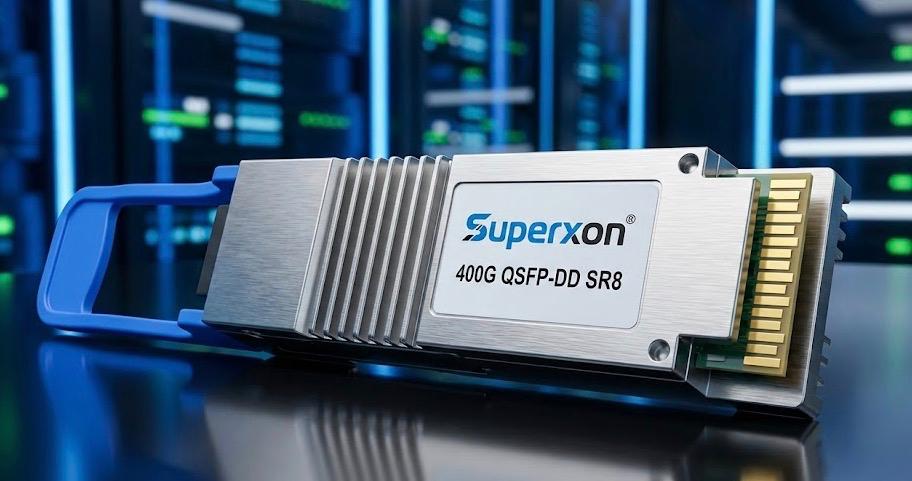
In hyperscale data centers, module failures mean downtime. Superxon’s 400G QSFP-DD family is engineered for reliability and power efficiency at the core:
Low Power Consumption: Optimized thermal design minimizes power dissipation. In data centers with thousands of modules, even small wattage savings translate to significant OpEx reductions in cooling and electricity.
Strict Interoperability: Rigorously tested for compatibility with major switch vendors (Cisco, Arista, Juniper, etc.), ensuring a seamless "plug-and-play" experience.
Advanced DSP: Top-tier 7nm DSP chips deliver exceptional BER (Bit Error Rate) performance—critical for stabilizing PAM4 signals.
The transition to 400G is inevitable for organizations scaling digital infrastructure. It requires a partner who understands both optical physics and data center business logic.
Explore the Superxon 400G Portfolio
Don’t let bandwidth limit your growth. View full technical specifications or request a sample for lab evaluation today.