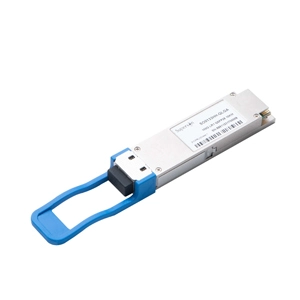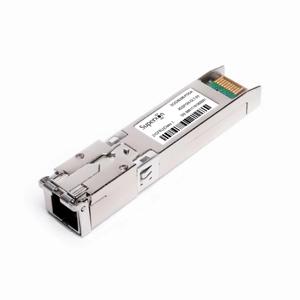
As cloud computing, artificial intelligence, and distributed storage drive unprecedented growth in data center traffic, network architects are migrating from 100G to 400G infrastructure to keep pace. The 400G QSFP-DD optical transceiver module has emerged as the primary interface for 400 Gigabit Ethernet (400GbE) links, providing the bandwidth density and reach required by hyperscale data centers, cloud providers, and telecom transport networks. For network design engineers, procurement teams, and data center integrators, understanding the differences between 400G QSFP-DD variants — SR4, LR4, and ER4 — is essential for matching the right module to each link distance, fiber type, and switching architecture. Superxon Optics, an optical transceiver manufacturer since 2007, produces 400G QSFP-DD modules compliant with QSFP-DD MSA and IEEE 802.3bs standards, covering distances from 100 meters to 40 kilometers.
A 400G QSFP-DD optical transceiver is a hot-pluggable fiber optic module that converts electrical signals from a switch or router port into optical signals for transmission over fiber, and vice versa. The "QSFP-DD" form factor — Quad Small Form-factor Pluggable Double Density — doubles the electrical interface of the traditional QSFP format, supporting eight lanes of 50 Gbps each using PAM4 (Pulse Amplitude Modulation 4-level) modulation to aggregate up to 425 Gbps total bandwidth.
Superxon's 400G QSFP-DD modules comply with the QSFP-DD MSA specifications and IEEE 802.3bs standard. The modules support 4x100GbE electrical lanes and are available in SR4 (short reach), LR4 (long reach), and ER4 (extended reach) optical variants. Digital diagnostic functions are available via the I2C interface, allowing real-time monitoring of optical power, temperature, and transceiver health. The modules operate on a standard 3.3V power supply and are RoHS compliant.
Three Variants for Different Reach Requirements: Superxon offers three 400G QSFP-DD models covering the most common data center and metro distances. The SR4 variant uses 850nm multimode fiber for 100-meter links via MPO connector. The LR4 uses LWDM wavelengths (1271/1291/1311/1331nm) over single-mode fiber for 10km via LC connector. The ER4 reaches 40km using CWDM wavelengths (1295.56/1300.05/1304.58/1309.14nm) over single-mode fiber with LC connector.
QSFP-DD MSA and IEEE 802.3bs Compliance: Full compliance with QSFP-DD MSA specifications and IEEE 802.3bs standards ensures interoperability with networking equipment from major switch manufacturers. Modules fit standard QSFP-DD ports without adapter requirements.
Hot-Pluggable Design: The hot-pluggable form factor allows modules to be inserted or removed without powering down the switch, simplifying maintenance, capacity upgrades, and module replacement in production networks.
PAM4 Modulation Technology: The modules use PAM4 modulation, which encodes two bits per symbol, doubling the data rate per lane compared to the NRZ modulation used in 100G QSFP28 modules. This enables 400G bandwidth within a compact form factor.
Commercial and Industrial Temperature Options: The SR4 and LR4 modules are available in both commercial (C) and industrial (I) temperature grades. The ER4 is offered in commercial grade, supporting deployment across different thermal environments.
Digital Diagnostics via I2C: The I2C management interface provides real-time access to optical transmit power, receive power, module temperature, supply voltage, and diagnostic flags — enabling proactive link monitoring and threshold-based alerting.
RoHS Compliant: All 400G QSFP-DD modules are RoHS compliant, meeting environmental regulations for hazardous substance restrictions.
3.3V Power Supply: Modules operate on a standard 3.3V supply, matching the power architecture of mainstream 400G data center switches and routers.
Hyperscale Data Center Switch-to-Switch Links: 400G QSFP-DD SR4 modules connect spine and super-spine switches over multimode fiber for distances up to 100 meters — the primary intra-data-center 400G link in cloud-scale facilities.
Data Center Interconnect (DCI): LR4 and ER4 modules provide single-mode fiber links between data center facilities at 10km and 40km respectively, supporting disaster recovery, workload migration, and distributed storage replication.
Cloud Provider Backbone Networks: Large cloud providers use 400G QSFP-DD modules to build high-capacity backbone links between regional data center clusters, enabling massive data movement for AI training, content delivery, and backup operations.
Telecom Transport Networks: 400G QSFP-DD modules serve as pluggable interfaces in telecom transport equipment, providing flexible alternatives to fixed transponders for high-capacity optical transport.
Metro and Regional Networks: ER4 variants serve metro and regional fiber links where 40km reach is required without intermediate amplification.
High-Performance Computing Clusters: HPC environments with massive inter-node bandwidth requirements benefit from 400G links for distributed computing, storage, and visualization workloads.
Selecting the correct 400G QSFP-DD variant depends on several factors:
1. Link Distance and Fiber Type: The primary decision factor. For links under 100 meters using existing multimode fiber (OM3/OM4), the SR4 variant with MPO connector is the most cost-effective. For distances beyond 100 meters, single-mode fiber is required, and the choice between LR4 (10km) and ER4 (40km) depends on the actual fiber run length.
2. Connector Type: SR4 uses MPO connectors for multimode fiber ribbon connections. LR4 and ER4 use standard LC duplex connectors for single-mode fiber. Ensure your fiber cabling infrastructure matches the connector type of the selected variant.
3. Wavelength Plan: SR4 uses 850nm over multimode fiber. LR4 uses LWDM wavelengths at 1271/1291/1311/1331nm. ER4 uses CWDM wavelengths at 1295.56/1300.05/1304.58/1309.14nm. Ensure the wavelength plan is compatible with any existing WDM infrastructure.
4. Switch Port Compatibility: Verify that the target switch or router port supports the QSFP-DD form factor and the specific 400GBase standard (SR4, LR4, or ER4). Confirm that the switch software supports PAM4 modulation and the module's digital diagnostics.
5. Temperature Grade: Commercial grade (0°C to 70°C) suits climate-controlled data center halls. Industrial grade is needed for outdoor cabinets, edge deployment, or environments with limited cooling.
6. Power Budget and Link Loss: For ER4 links, calculate fiber attenuation, connector losses, and splice losses against the module's power budget. Single-mode fiber attenuation at 1310nm is typically 0.35 dB/km.
7. Diagnostic and Management Requirements: If the network management system relies on digital optical monitoring (DOM), confirm the module provides I2C-based digital diagnostics for real-time parameter tracking.
Superxon Optics brings several practical advantages as a 400G QSFP-DD supplier:
Product Series Coverage: 400G QSFP-DD modules in SR4, LR4, and ER4 variants — plus a broader portfolio spanning 1G to 400G — allowing buyers to source multiple transceiver speeds from one supplier.
MSA and IEEE Compliance: Products compliant with QSFP-DD MSA and IEEE 802.3bs, supporting interoperability with mainstream networking equipment
OSA Manufacturing Capability: In-house design and manufacture of Optical Sub-Assemblies (BOSA, QUOSA), providing control over critical optical components that determine transceiver performance.
Technical Communication: Engineering team available for specification matching, compatibility verification, and application-based recommendations.
OEM/ODM Support: Customized labeling, packaging, and specification options for distributors and brand owners.
Quality Assurance: ISO 9001-aligned production with optical, electrical, thermal, and environmental testing at multiple checkpoints.
Industry Experience: Optical transceiver design and manufacturing since 2007, with product lines covering PON, data center, and telecom applications.
Choosing the right 400G QSFP-DD transceiver comes down to matching link distance, fiber type, connector compatibility, and environmental conditions to the correct variant. Superxon Optics' SR4, LR4, and ER4 modules cover the full range of hyperscale data center and metro link requirements — from 100-meter multimode connections to 40-kilometer single-mode runs — all built to QSFP-DD MSA and IEEE 802.3bs standards. If you are specifying 400G transceivers for a new hyperscale data center build, a DCI link, or a network upgrade, contact Superxon Optics to discuss your link requirements, review detailed datasheets, and request evaluation samples.